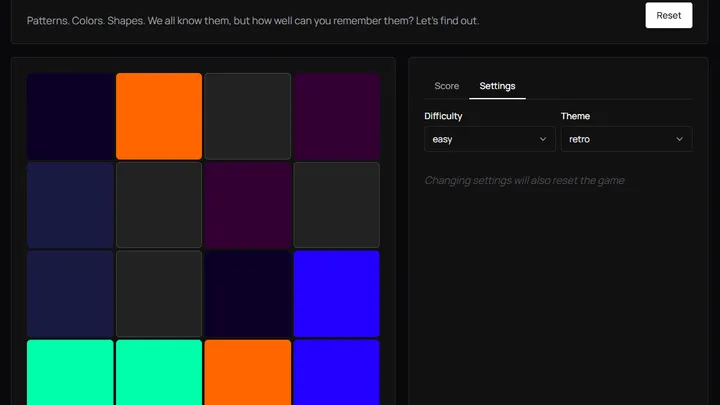
Memo started as an excuse to try Jotai. I wanted to understand how atom-based state management feels in practice, and a memory matching game seemed like a good fit. There's enough state complexity to be interesting but not so much that it buries the thing you're actually trying to learn.
It turns out Jotai is a really natural way to model game logic. The core game state lives in a handful of atoms, and the rules - checking matches, tracking moves, watching for win/loss conditions - are just derived atoms that react to changes. There's a clean separation between "what happened" and "what does that mean" that I found satisfying to work with. Settings persist to localStorage through atomWithStorage, which is about two lines of code.
The game itself is straightforward. Flip tiles, find pairs. I added difficulty presets (easy, medium, hard) and a custom mode where you can dial in grid size, move limits, and time limits. A few friends and I played it for a while, which was a good excuse to keep polishing it.
Themes
There are 8 tile themes across three types:
- Colors: 4 palettes ranging from a classic set to gradients and a retro neon look
- Emoji: flags, food, and faces
- Images: memes, obviously
The theme system is generic enough that adding new ones is just dropping values into an array.
Stack
React 19, TypeScript, Vite, Chakra UI. Jotai handles all game and settings state. Vitest for testing. The whole thing is a static SPA with no backend.